My plunge into reading New Mexico geology has taken me back to my first weeks as an undergraduate at Michigan State when I realized there were a great many people in my classes who had attended much better public schools than I.
I recognized I either had to work harder to stay even or fall below my personal standard, which wasn’t particularly high, given that mediocre school system, but still high enough to refuse to accept failure.
I remember making the decision some Saturday when my room mates went off to the football game and I stayed behind to study. That day alone, when I first forsook the life of parties, I began developing an ability to teach myself.
It’s a helpful skill now when I read books or articles that claim to be aimed at both the beginning graduate student and the professional. They assume a level of knowledge, mainly about plate tectonics, but also volcanism, that I simply don’t have. It means constant on-line connections to find the definitions of words and concepts.
Fortunately, no one I’ve read so far expects a greater knowledge of chemistry or physics than I have. My high school science teachers were among my worst. Unlike botany, which has been so revolutionized by biochemistry that after some five years of reading about plants I still have difficulty with articles about photosynthesis that assume an understanding of concepts like feedback mechanisms and communication pathways, most of the geology I’ve read so far expects no more than a recognition of the symbols for elements, a minimal understanding of how compounds change, and the understanding of the technical definitions of words like reduction that have broader, general meanings.
This is probably because many senior geologists, those of my general generation, don’t know much more than they learned in high school. Once they specialized, they didn’t need to know more.
This shows most in their attempts to continue to use the basic concepts of Newtonian mechanics relating to the behavior of heat to explain the, to them, new phenomenon of plate tectonics. I don’t know if this was a valid assumption or not, but it was an understandable one given the conservative nature of both science and the human mind.
This brings me to the second thing I realized my first term in school, that I was more interested in interdisciplinary studies than specialized ones. MSU then had a required freshman course called American Thought and Language, which sought to meet the history, English and composition requirements in a single class that placed important writers in their cultural context.
I think I may have spent that long ago Saturday reading Roy Horton and Herbert Edwards’ Backgrounds of American Literary Thought, the first unassigned book I ever bought, trying to understand what my professor was saying about Puritanism. By chance it was the one he was using to prepare his lectures.
I found I wasn’t interested in knowing more and more about Emerson or the XYZ Affair, which is where a major in English or history inevitably leads. I wanted to know about the houses where readers of Emerson lived and the influence of the French more than I did transcendentalism or diplomatic history.
Such a pursuit, if it’s to be more than gadfly dilettantism, requires some discipline, as my graduate school professors never tired of telling us. More important it demanded that ability to plunge into reading something beyond one’s existing level of knowledge.
This brings me to the third thing I realized that first term in college, that no matter how much one learns, there’s always something beyond that’s unknown. Some are so taunted by that edge it drives them to push the frontiers of knowledge. It sends others with a strong desire for explanations into deep theological inquiries.
I realized one is either driven or tormented or one sets limits. I learned to recognize the point where the answers to my questions were pulling me into areas I wasn’t interested in pursuing, and simply accepted that such was the case and I could exist without knowing.
Deciding what to pursue and what to ignore is something we all do to get through the day. Someone once asked Penelope Lively, a novelist who delineated the undercurrents in human relations, how, once she was aware of such things, she could ever get through the mechanics of a family meal when a person simply must ask another to pass the butter.
Geologists must make those decisions when they write an article. They define the purpose, then exclude things that are extraneous. When Steven Whitman and Karl Karlstrom wrote about the formation of the North American continent, they realized their contribution was a series of drawings showing the progression through time. Indeed, one can learn a great deal by only looking at the pictures.
Their supporting evidence was drawn from the rocks themselves. They assumed you knew the rocks. I’m less interested in specific rocks than geologists or rock hounds, and so took their facts as facts not to be bothered with yet. I wanted to know why, not how to properly identify or date a specimen.
They took the Precambrian world as a given. They assumed you knew what that was or that it didn’t matter to understanding the phenomenon they were describing. As an historian, I was lost. If this part of New Mexico began as an island arc, I needed to know more about the ocean at that time, something they barely mention.
I went on line and innocently keyed in the search words Precambrian and ocean. I discovered some German heavy metal group called The Ocean had recorded an album called Precambrian. Interesting, but not what I wanted to know.
With some refinements in my Google search, I eventually found a chapter by Steve Kershaw on Precambrian oceans in his book, Oceanography. He was interested in why the earth didn’t freeze in its early years when the young sun wasn’t as hot as it would become, and so devoted a great deal of space to the Young Sun Paradox.
That’s indeed an interesting question, but not what I immediately needed to know. However, to cover his material for that hypothetical new graduate student, he did mention things I did want to know: when the oceans came into being, how deep they were, how much space they covered.
In the process he also suggested something I hadn’t thought about, how changes in the chemistry of sea water, as recorded by rocks, affected the development of islands like those that would become New Mexico.
The final thing I learned, not my freshman year, but when I actually became that hypothetical graduate student in American studies, is that no one ever tells you exactly what you want to know.
Whitmeyer, Karlstrom and Kershaw have all told me things I need to know, but they are writing for a general audience. It’s going to be up to me to figure out what it means for understanding the geological history of the place I live in the Rio Grande rift valley.
Showing posts with label Plate Tectonics. Show all posts
Showing posts with label Plate Tectonics. Show all posts
Friday, November 11, 2011


Sunday, October 16, 2011
La Bajada

How do you know a book is fraudulent?
When it purports to give a driver an explanation of all the important geological features visible from a car, and, in the section on I-25 from Albuquerque to Santa Fe, doesn’t mention La Bajada Hill.
The La Bajada escarpment rises some 800' from the Santo Domingo basin. The first road, built by the army in the 1860's, had some 28% grades. When the last territorial governor, William Mills, had a better road built in 1910, it had 23 hairpin turns or switchbacks to make the mile and half climb with a maximum 7.8% grade. Railroads then couldn’t handle more than 3%.
Fraudulent may be too strong a term for a book that does provide some useful information, but La Bajada’s not something you can miss if you’re driving south from Santa Fe. You do wonder if the author ever made the drive.

The city was founded in 1610 by Pedro de Peralta as a safer, perhaps better watered, alternative to the Española valley. It was conceived as a citadel.
To get there from the river you had to scale the walls of White Rock Canyon. To get there from the north you had to climb what we now call Opera Hill from the Tesuque valley. To get there from the east you had to cross the Sangre de Cristo. To get there from the south you had to come up La Bajada from the Galisteo river.
The Atkinson, Topeka and Santa Fe Railroad refused to come. It’s engineers skirted the Sangre de Cristo to find an opening to the south. To pacify the local politicians they built a station at Lamy and left it to them to get their goods uphill.
Route 66 originally climbed the hill, but was the source of great complaint by Fred Harvey’s organization who wanted to give rail passengers local tours on buses. When governor Arthur Thomas Hannett suggested rerouting the road from Santa Rosa to Albuquerque, merchants in Santa Fe protested. He was not re-elected in 1927. In the remaining month of his term the former member of the State Highway Commission had the Santa Rosa cutoff built anyway.

The present La Bajada road was built in 1932 three miles east of the original, and later improved for the interstate system. The old road still exists for fans of Route 66. However, it’s not maintained and requires a different vehicle than mine.
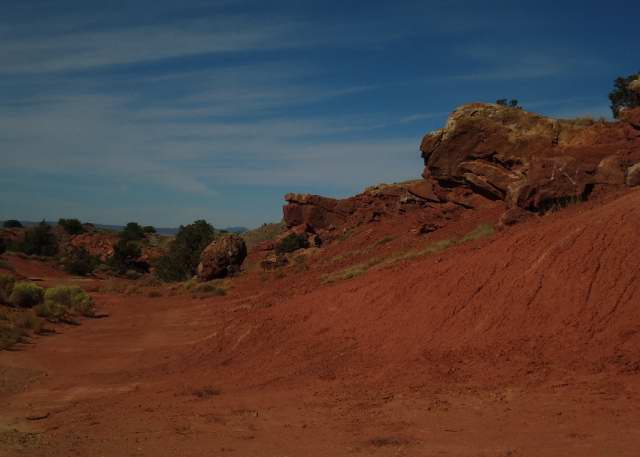
The modern road is still a thrill to drive, at least coming down. You want to look out over the opening vistas of red stone but need to keep the car from accelerating too quickly while others are passing you at much greater speeds.

Going up there’s a third lane and the sheer incline modulates people’s speed. However, because you’re rising through wooded land the ascent seems darker and less exciting than the descent.
Going down, you can’t pull off until you’re at the bottom at the exit to Cochiti Pueblo, which is where these pictures were taken Saturday. They don’t capture the vertigo, but they suggest why I can always tolerate driving to Albuquerque.
Note: For more on the La Bajada road, see David J. Krammer, “Historic and Architectural Resources of Route 66 through New Mexico,” prepared for the National Register of Historic Places in 1993.
Subscribe to:
Posts (Atom)