Showing posts with label La Bajada. Show all posts
Sunday, October 16, 2011
Geology for Dummies*
* Well, not exactly dummies - but for those of us born into an earlier era, there comes a time when it’s necessary to step back and try to grasp what any modern child might learn today in grade school.
When I was young in glacier dominated Michigan there were simply seven continents, and some rather mysterious drawings of folds, faults and subduction zones. Since nothing really mattered before the Pleistocene, I ignored those drawings.
Since then, scientists have agreed on the existence of plate tectonics and continents are no longer givens, but the results of processes. Here in the Española Valley we’re on the boundaries of plate activity that I’ve spent the past few hours trying, once again, to understand.
The Wikipedia entry on the Wyoming Craton has a useful schematic showing the elements that coalesced or were absorbed into the Laurentian plate that became North America. This part of New Mexico was somewhere on the boundary of the collision of a southeast facing section of that continent with Yavapai-Mazatzal that resulted in lines of weakness that were subsequently buried under layers of sedimentary shale, sandstone and limestone.
Laurentia later overrode the Farallon plate in the Pacific. As the last, western most section of Farallon was swallowed, undissolved bits on the eastern side tipped up as part of the mountain building that produced the Sangre de Cristo.
When the Farallon plate finally did disappear, one section of the North American plate began rotating clockwise to drift into the newly vacated area. As it shifted, the great rift began to open as one part of the land shifted with it and another stayed in place. As the rift expanded, blocks of land roughly defined by those old Yavapai-Mazatzal collision lines dropped, some facing east, some facing west and magma welled through the Jemez Lineament.
The Emdudo faults are the southwest-northeast northern frontier of the Española valley and the La Bajada faults part of the southwest-northeast running southern one. Almost no displacements occur without some tilting. Those visible at the Cochiti exit are mild, those a few miles away at the Garden of the Gods are extreme.
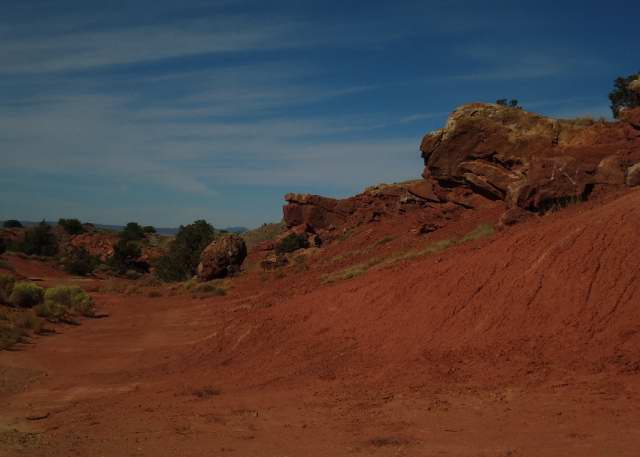
The layers everywhere are probably the same, but what’s visible is probably as much a function of road building as natural forces. At La Bajada the lower red stones are more visible than the lighter colored stones above that either are covered or have washed away. At the Garden of the Gods, the limestone has lasted longer than the softer red sediments.
Above picture from Garden of the Gods on State Road 14; the others from La Bajada at the Cochiti exit.
Labels:
Embudo,
Española,
Garden of the Gods,
Geology,
La Bajada,
New Mexico,
Rio Grande Rift Valley,
Sedimentary Rock
La Bajada
How do you know a book is fraudulent?
When it purports to give a driver an explanation of all the important geological features visible from a car, and, in the section on I-25 from Albuquerque to Santa Fe, doesn’t mention La Bajada Hill.
The La Bajada escarpment rises some 800' from the Santo Domingo basin. The first road, built by the army in the 1860's, had some 28% grades. When the last territorial governor, William Mills, had a better road built in 1910, it had 23 hairpin turns or switchbacks to make the mile and half climb with a maximum 7.8% grade. Railroads then couldn’t handle more than 3%.
Fraudulent may be too strong a term for a book that does provide some useful information, but La Bajada’s not something you can miss if you’re driving south from Santa Fe. You do wonder if the author ever made the drive.
The city was founded in 1610 by Pedro de Peralta as a safer, perhaps better watered, alternative to the Española valley. It was conceived as a citadel.
To get there from the river you had to scale the walls of White Rock Canyon. To get there from the north you had to climb what we now call Opera Hill from the Tesuque valley. To get there from the east you had to cross the Sangre de Cristo. To get there from the south you had to come up La Bajada from the Galisteo river.
The Atkinson, Topeka and Santa Fe Railroad refused to come. It’s engineers skirted the Sangre de Cristo to find an opening to the south. To pacify the local politicians they built a station at Lamy and left it to them to get their goods uphill.
Route 66 originally climbed the hill, but was the source of great complaint by Fred Harvey’s organization who wanted to give rail passengers local tours on buses. When governor Arthur Thomas Hannett suggested rerouting the road from Santa Rosa to Albuquerque, merchants in Santa Fe protested. He was not re-elected in 1927. In the remaining month of his term the former member of the State Highway Commission had the Santa Rosa cutoff built anyway.
The present La Bajada road was built in 1932 three miles east of the original, and later improved for the interstate system. The old road still exists for fans of Route 66. However, it’s not maintained and requires a different vehicle than mine.
The modern road is still a thrill to drive, at least coming down. You want to look out over the opening vistas of red stone but need to keep the car from accelerating too quickly while others are passing you at much greater speeds.
Going up there’s a third lane and the sheer incline modulates people’s speed. However, because you’re rising through wooded land the ascent seems darker and less exciting than the descent.
Going down, you can’t pull off until you’re at the bottom at the exit to Cochiti Pueblo, which is where these pictures were taken Saturday. They don’t capture the vertigo, but they suggest why I can always tolerate driving to Albuquerque.
Note: For more on the La Bajada road, see David J. Krammer, “Historic and Architectural Resources of Route 66 through New Mexico,” prepared for the National Register of Historic Places in 1993.
Labels:
Geology,
Jemez Lineament,
La Bajada,
New Mexico,
Plate Tectonics,
Route 66,
Sangre de Cristo,
Santa Fe Group,
White Rock Canyon,
Yavapai-Mazatzal
Subscribe to:
Comments (Atom)